Tuesday, October 29, 2013

The Government wants to teach all children how to code. Here's why it's a stupid idea – Telegraph Blogs

The Government wants to teach all children how to code. Here's why it's a stupid idea – Telegraph Blogs:

As a subject, it only appeals to a limited set of people – the aforementioned dull weirdos. There’s a reason most startup co-founders are “the charming ideas guy” paired with “the tech genius”. It’s because if you leave the tech genius on his own he’ll start muttering to himself.
'via Blog this'

As far as this commentator, teaching coding is a bad idea. He concludes-
If a school subject is to be taught to everyone, it needs to have a vital application in everyday life – and that’s just not true of coding. Sure, it’s useful for some kids, but it doesn't begin to compare with basic maths, spelling or reading. 


Saturday, August 24, 2013

The Evolution of the Web

The Evolution of the Web:
as seen through web browsers and web technologies. It gets quite complicated the closer to the present one gets.

'via Blog this'

Sunday, January 6, 2013

Stephen Coles’ The Anatomy of Type, reviewed. - Slate Magazine

Stephen Coles’ The Anatomy of Type, reviewed. - Slate Magazine: "In 2008, a typeface won a presidential election. At least, that's the impression you may have gotten if you read one of the countless stories extolling the virtues of Gotham. Originally commissioned for a GQ redesign, Gotham came to define the Obama campaign's clean visual signature. "

'via Blog this'

Tuesday, September 25, 2012

PBS Off Book series has a video about web design.

Wednesday, September 19, 2012

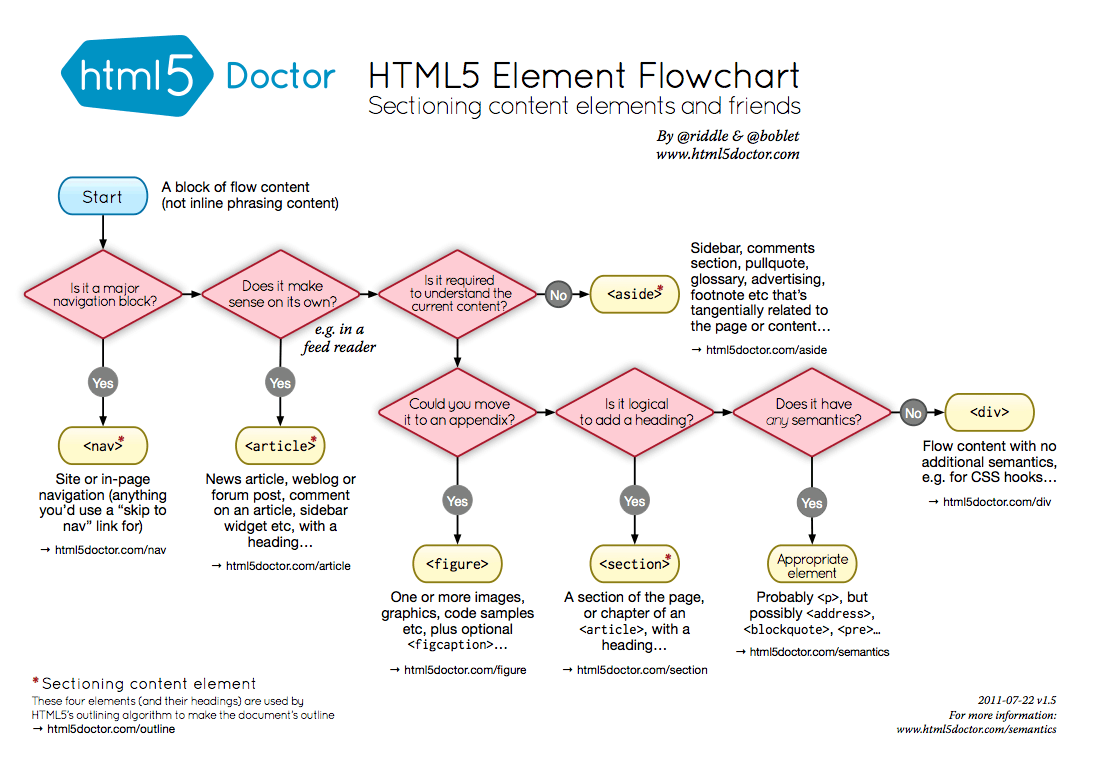
HTML5: Section or Article? | Ian Devlin

HTML5: Section or Article? | Ian Devlin: "One of the main questions I have seen popping up all over the place in relation to HTML5, in forums, StackOverflow, and Twitter, is “which do I use: article or section?”"
'via Blog this'

This article presents an interesting viewpoint on the section and article tags we have been discussing in terms of HTML5.

Sunday, September 16, 2012

Post-Web2.0 design trends

Smashing UX describes the latest trend in web page design
Since Elliot Jay Stocks so poignantly told us to destroy the Web 2.0 look, we’ve witnessed a de-shinification of the Web, with fewer glass buttons, beveled edges, reflections, special-offer badges, vulgar gradients with vibrant colors and diagonal background patterns. The transformation has been welcomed with relief by all but the most hardened gloss-enthusiasts. However, design and aesthetics work in mysterious ways, and no sooner does one Web design trend leave us before another appears.
 The new trend has a number of interesting "skeuomorphic features" which makes one wonder if beyond Web 2.0 there is the re-valuation of the physical, like the rebirth of vinyl records--things which work better in the analogue/physical world, or if this is just the last stylized gasp of things which--after all--work better in the virtual world. Or perhaps we are so confused we have lost track of which is which.

Tuesday, February 7, 2012

Friday, February 3, 2012

Web Typography

Opinionated piece about typography and the web Elegant Web Typography

Sunday, January 22, 2012


If you've ever used Apple's Keynote or Pages (or Microsoft's PowerPoint or Word) apps, then you should be able to hit the ground running in iBooks Author. There are templates for different types of book layouts, and adding the interactive 3-D models, photos, videos and diagrams that Apple demoed iBooks 2 textbooks on Thursday is as easy as clicking and dragging a built-in widget -- provided you've already produced the video, photos, diagrams and models you want to use. 
Apple has even built into iBook Author HTML5 and Javascript support for programmers looking to take their books beyond what the app can do itself; multi-touch interactions for pinch and zoom views of photos and swiping gestures are also included.

Wednesday, January 4, 2012


Time to pop open the champagne because, based on the latest data from Net Applications, IE6 usage in the US has now officially dropped below 1%! IE6 has been the punch line of browser jokes for a while, and we’ve been as eager as anyone to see it go away. In fact, we launched the IE6 Countdown site last March to help accelerate the process. Less than a year later, I’m thrilled to say that the United States has joined the ranks of Austria, Poland, Sweden, Denmark, Finland and Norway in dropping below 1% usage of IE6.

Thursday, December 15, 2011

From Christian Heilmann
There is a lot of discussion right now about HP’s new logo. I for one like it as they can save an HTTP request by creating it with CSS:

Tuesday, April 12, 2011

Friday, February 11, 2011

Search Engine Optimization to Lure Readers - NYTimes.com

Search Engine Optimization to Lure Readers - NYTimes.com:
Fascinating article on current trends in Search Engine Optimization (SEO)
“You’re not really crossing the line if you’re creating content for the sake of disseminating information, like HuffPo,” said Vivek Wadhwa, visiting scholar at the School of Information at the University of California, Berkeley. “The problem is these other players producing content based on what people click on.”

Those publishers, which many dismissively refer to as content farms, include Demand Media, Yahoo’s Associated Content and AOL’s Seed.

Demand Media uses software that looks at activity on search engines, Facebook and Twitter; generates headlines based on it; and assigns freelancers to write corresponding pieces. The result is articles like “How to Lose Weight in Your Face,” which is a top Google result for related searches and includes tips like “drink plenty of water.”

Monday, February 7, 2011

Typography for Lawyers

Typography for Lawyers
This looks like an intelligent and interesting book.
Download a sample and you will see what I mean.

Saturday, January 22, 2011

How novels came to terms with the internet | Books | The Guardian

How novels came to terms with the internet | Books | The Guardian
...that machinery isn't going away, even if it does assume new forms and new powers to go with those forms. It's more than just the way we live now, it is the world we've made for ourselves, out of our selves. Like it or not, we're stuck with us.

Sunday, January 16, 2011

Report warns of 'digital Dark Age' if digitisation is left to private sector | Books | guardian.co.uk

Report warns of 'digital Dark Age' if digitisation is left to private sector | Books | guardian.co.uk:"

In Europe there is anxiety over Google's domination of digitization. A new report suggests how governments should respond, and what kind of limits may be imposed on Google's control of cultural content:

The report, the work of German national library head Elisabeth Niggeman, advertising chief Maurice Levy and Belgian author Jacques de Decker, recommends much greater focus on the EU's online library Europeana and the fostering of competitors to Google, which currently dominates the digitisation agenda. "Can Europe afford to be inactive and wait, or leave it to one or more private players to digitise our common cultural heritage? Our answer is a resounding 'no'," the trio say.


--

Monday, October 25, 2010

Do writers need paper? � Prospect Magazine

Do writers need paper? Prospect Magazine
“Here’s a stray question,” DeLillo continued. “Will language have the same depth and richness in electronic form that it can reach on the printed page?

Tom Chatfield's essay on writers' views of the ebook revolution. Some predictable and some interesting thoughts emerge.

Sunday, October 24, 2010

The HUMLab blog :

The HUMLab blog :
Jessica Pressman, Yale University

What happens to literature, the literary, and the cultural value of both when text moves from page to screen? In my book project, Digital Modernism, I examine a prominent strategy in some of the most innovative works of electronic literature online: the appropriation and adaptation — the remediation— of literary modernism. The works I call “digital modernist” challenge assumptions about electronic literature forged in the last two decades. They foreground textual narrative, reject interactivity, and seek aesthetic difficulty. Instead of celebrating all that’s new in new media, these works adopt a modernist practice of returning to the past for inspiration. In this talk, I present my research by explaining how and why modernist cultural principles and poetic practices serve digital experiments. At stake, I argue, is an understanding of the role of literary art, critical reading practices, and humanistic culture in our networked age.

Monday, September 13, 2010

Instant Color Schemes

Instant Color Schemes:
"Let Yahoo pick your color scheme! Enter a word or phrase and I'll grab 5 related images from Yahoo Images, and get the 6 most prominent colors from each."

Really cool idea, but you have to try it to see if you can really get something interesting with words that are not obviously colour related.
--

Sunday, March 14, 2010

on compensation - Bethany Nowviskie

on compensation Bethany Nowviskie:
"Perhaps the attitude toward “work” I find disappointing in some members of this new DH wave comes from a lack of experience in defining a digital humanities problem and then building tools and datasets from scratch to address it. (That’s an activity much like traditional editorial work and bibliographic scholarship — which has also been, in recent decades, though certainly not always, or even in the memory of some of our senior colleagues in English departments, an activity marginalized and denigrated as akin to “service.”) Or perhaps a certain turn of mind kept those people away from our more risky, Wild West days in the first place. It is also entirely possible that the tendency I have noticed in some established scholars new to the digital humanities — a tendency to view what I would consider to be their own, deeply intellectually engaging research and scholarship as “uncompensated work” insofar as it employs digital tools and methods — stems from causes mysterious to me as they exist outside my own experience in the academy, or beyond the quirks of my own work ethic."